Uses of Sand
Sand is in the concrete under your feet, the glass in your windows and the water in your tap. Here are about fifty of the ways we use it, and why each job needs a particular kind of grain.
Sand is a size, not a material
To a geologist, "sand" means any grain between 1/16 of a millimeter and 2 millimeters across (about 1/400 to 1/13 of an inch). Finer than that is silt and clay; coarser is gravel. It says nothing about what the grain is made of. Beach quartz, black volcanic glass, crushed shell, garnet, sea glass and the copper slag left over from smelting are all sand if they are the right size. Engineers use almost the same definition, with slightly different cut-offs (about 0.075 mm to 4.75 mm).
That is why the uses below are so varied. Some need sand that nature made — rounded by rivers, sorted by waves. Others need sand that people made on purpose, by crushing rock or firing chemicals in a furnace. Throughout these pages, natural sand means grains nature produced, and manufactured sand means grains made or treated deliberately because someone wanted sand.
Part 1 — The big picture, building and industry Contents ↑
How much sand do we use?
The United Nations Environment Programme estimates that the world uses roughly 50 billion metric tons of sand and gravel a year — enough to build a wall 27 meters (89 feet) wide and 27 meters high around the equator, every year. UNEP calls sand and gravel the second most used resource on Earth after water. Demand has grown about fivefold since 1970, driven mostly by concrete, roads and land reclaimed from the sea, and UNEP expects building demand to keep rising.
Two cautions. First, the figure is for sand and gravel together, and it is an estimate: no country-by-country monitoring of sand use exists. Nor does it say how much is natural sand and gravel and how much is manufactured sand made by crushing rock; no worldwide figure for that split seems to exist. Second, the world is not "running out of sand" in the sense of the planet lacking it. Deserts are full of sand. The shortage is of the right sand, in the right place, that can legally be dug. In the United States alone, about 870 million metric tons of natural construction sand and gravel were produced in 2025, from about 6,500 pits. US quarries also produced about 1.5 billion metric tons of crushed stone, and manufactured sand comes out of that side of the industry. Most countries don't report figures that can be compared with that.
Sources
Sand mining and the "sand mafia"
Where demand is high and rules are weak, sand is dug illegally from riverbeds and beaches. UNEP's 2019 report described "sand mafias" operating in countries including Cambodia, Vietnam, India, Kenya and Sierra Leone. Over-mining lowers riverbeds and water tables, erodes coasts and starves river deltas of the sediment that keeps them above sea level.
In India the trade has turned violent. Journalist Vince Beiser counted at least 70 people killed in sand-mining violence there since 2014, including police officers and whistleblowers. Several Indian journalists who reported on illegal mining have been attacked or have died, although the circumstances of some deaths are disputed. Beiser's book The World in a Grain (2018) is the best general read on the whole subject.
Sources
Concrete
Concrete is the largest single use of sand. It is cement, water, sand and gravel (or crushed stone) mixed together; the sand is the "fine aggregate" that fills the spaces between the larger stones, makes the mix workable and bonds with the cement paste. In the US about 42% of all construction sand and gravel goes into concrete.
Concrete production is responsible for roughly 8% of the world's carbon dioxide emissions. Almost all of that comes from making the cement, not from the sand or the trucks. About half is released by the chemistry itself: limestone heated in a kiln breaks down into lime and gives off carbon dioxide. Most of the rest comes from the fuel burned to heat the kiln to about 1,450 °C (2,640 °F).
Concrete sand has to meet a standard (ASTM C33 in the US): clean, hard grains with no clay, organic matter or salt, and a good spread of sizes from coarse to fine. This is why desert sand is mostly no good for concrete, even in countries surrounded by it. Wind wears desert grains small, rounded and very evenly sized. Evenly sized grains leave gaps that have to be filled with extra cement, and the result is weak. Gulf states with endless deserts import sand for construction. Researchers are working on ways to use desert sand, but so far only for things like paving blocks.
The same property that makes desert sand bad for concrete makes rounded sand valuable for other jobs — see frac sand and glass below.
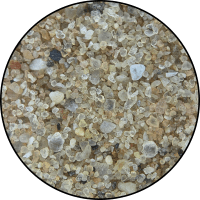
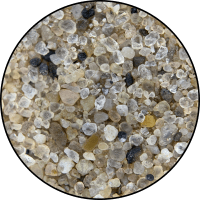
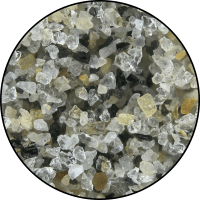
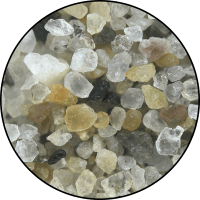
From the collection: two samples of wind-sorted desert sand from the Algodones Dunes in California, 0432 and 0023. Compare how evenly sized their grains are with a beach sand such as 0423 Oceanside.
Sources
- USGS MCS 2026, Construction Sand and Gravel
- Chatham House, "Making Concrete Change" (2018; cement's share of CO2 and where it comes from)
- NTNU on making concrete from desert sand (2026)
- Norwegian SciTech News, interview with the researcher
- Yang et al. 2024, properties of wind-blown sand (open access)
Asphalt
An asphalt road is about 95% stone, gravel and sand by weight, held together by about 5% asphalt binder made from crude oil. About 9% of US construction sand and gravel goes into asphalt. Old asphalt is ground up and put back into new roads in every US state.
Asphalt wants angular, rough sand. Sharp-edged grains lock together and resist the ruts that heavy trucks press into a road on hot days, and rough surfaces hold the binder. Many highway agencies limit how much rounded natural sand can go into a heavy-traffic mix for exactly that reason.
Mortar, plaster and stucco
Mortar glues bricks and blocks together; plaster and stucco coat walls. All three are a binder (cement, lime or gypsum) plus sand plus water. Each has its own sand standard, because the sand changes how much water the mix needs: mortar sand can carry more very fine particles, while stucco made with fine mortar sand needs extra water and ends up weaker and more prone to cracking. Clean sand matters for all three — clay, silt or organic matter weakens the bond.
Land reclamation
Whole districts, airports and islands have been built from sand pumped out of the sea. Singapore has grown by roughly a fifth since 1960, much of it on imported sand — enough that when neighboring countries banned sand exports (Indonesia in 2007, Cambodia by 2017), Singapore began trialing ways to reclaim land with less of it. Dubai's Palm Jumeirah was built from roughly 100 million cubic meters (130 million cubic yards) of sand dredged from the Persian Gulf floor, held in place by a breakwater of about 7 million metric tons of rock. Survey data show the island is still settling by about 5 millimeters (0.2 inch) a year.
Reclamation sand doesn't need to meet concrete standards, but it must be clean and free of silt so it drains and packs down firmly once it is pumped into place.
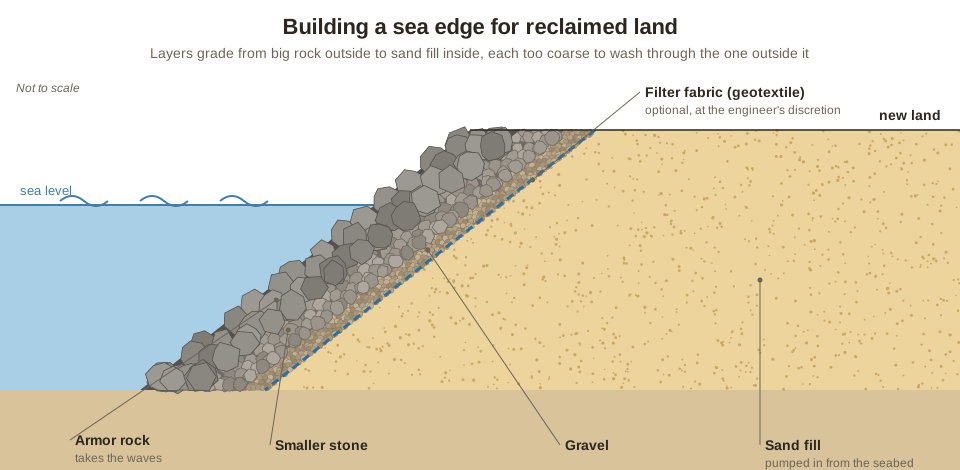
The edges have to be armored so waves can't wash the fill away. A sea edge is usually built in layers: big armor rock on the outside, then smaller stone, then gravel, grading down to the sand fill, with each layer too coarse to wash out through the gaps in the one outside it. Engineers may also lay a filter fabric (geotextile) between layers.
Sources
Beach replenishment
Many beaches are kept alive by moving sand onto them. Dams trap river sand that once reached the coast, and seawalls and harbors interrupt its movement along the shore. In San Diego County, California, SANDAG's Regional Beach Sand Projects dredged sand from offshore and pumped it onto eroded beaches: about 1.7 million cubic meters (2.2 million cubic yards) onto 12 beaches in 2001, and about 1.1 million cubic meters (1.5 million cubic yards) at Imperial Beach, Oceanside, Carlsbad, Encinitas and Solana Beach in 2012. A Scripps study found the 2012 beaches were, on average, about 10 meters (33 feet) wider four years later, even after a strong El Niño winter — and credited the fact that the new sand was coarser than the native sand. A third project is now being planned.
Replenishment sand has to be "beach-compatible": similar to the native sand, or slightly coarser, with very little silt or clay. Sand that is too fine washes away quickly and clouds the water. Replenishment is also a trade-off rather than a cure: beaches have to be re-fed, and surfers have raised concerns about new sand burying reefs and changing breaks.
From the collection: 0423 Oceanside, one of the San Diego County beaches fed with replenishment sand in 2001 and 2012.
Sources
Glass
Glass is mostly melted sand, but not just any sand, and not sand alone. A typical bottle or window is about 70–74% silica, with soda ash and limestone added. Soda ash is sodium carbonate, a white powder that in the US is refined mostly from trona, a mineral mined in Wyoming; it lowers the temperature at which the batch melts. Limestone makes the finished glass hard and keeps it from dissolving in water. Glass sand must be very pure quartz — usually 99% silica or better — with almost no iron, because iron tints glass green or brown. It also needs a narrow range of grain sizes so it melts evenly. That sand comes from particular clean quartz sandstones, not from beaches, which carry shell, dark minerals and iron.
About 7% of US industrial sand goes into glass. Recycling helps: about a third of US glass containers are recycled, and crushed old glass in the furnace cuts the amount of fresh sand needed.
Sources
Computer chips and solar panels
"Computer chips are made from sand" is only half true. The silicon in chips and solar cells comes from quartz — the same mineral as most sand — but usually from lump quartz or quartzite rock rather than beach sand. The quartz is heated with carbon in an electric furnace at about 2,000 °C (3,600 °F) to make silicon that is about 98% pure. For chips, that is then chemically refined to 99.9999999% pure — "nine nines," or only about one atom in a billion that isn't silicon. Silicon for solar cells doesn't need to be quite that pure.
One small town is central to the whole industry. Spruce Pine, North Carolina, supplies an estimated 70–90% of the world's high-purity quartz, which is used to make the crucibles that hold molten silicon while the large single crystals for chips are grown. That quartz comes from pegmatite rock in the Blue Ridge Mountains, not from sand. When Hurricane Helene shut the mines in September 2024, the chip industry worried about supply.
Sources
Frac sand (oil and gas)
By weight, the biggest use of industrial sand in the US is oil and gas drilling: about 81% of it. In hydraulic fracturing, fluid is pumped into rock at high pressure to crack it, and sand is carried into the cracks to prop them open so oil and gas can flow out. The sand is called a "proppant."
Frac sand needs the opposite of concrete sand: round, spherical, strong quartz grains that won't crush under the weight of the rock above. The premium product, "Northern White" sand from Wisconsin and Minnesota, is old quartz sand that was rounded long ago. A rounded grain spreads the pressure evenly, and the round grains leave open spaces between them for oil and gas to flow through.
Sources
Foundry sand (metal casting)
Engine blocks, pipe fittings and manhole covers are cast by pouring molten metal into a mold made of packed sand. Most iron and steel castings use "green sand": silica sand mixed with about 5–10% bentonite clay and a little water, so it holds a shape. (The "green" means damp, not the color.) The hollow insides of castings are formed with cores of sand glued with resin.
Foundry sand must be uniform and able to take extreme heat without breaking down. US foundries throw away somewhere around 5–9 million metric tons (6–10 million US tons) of used sand a year. Most of it goes to landfill: the EPA estimates that only about 2.4 million metric tons (2.6 million US tons) a year are put to other uses. The EPA has found that sand from iron, steel and aluminum foundries can be safely reused in road base and manufactured soil.
Sources
Ceramics, fiberglass and optical fiber
Potters use finely ground silica — quartz sand milled to a flour — in clay bodies, where it controls shrinkage, and in glazes, where it is the main ingredient that turns to glass in the kiln (around 30% of a typical stoneware glaze). Fiberglass is glass spun into fine threads, made from a batch that is mostly silica sand with clay, limestone and a boron mineral. It ends up in house insulation, boat hulls, car bodies and storage tanks, and insulation can contain up to 40% recycled glass.
The optical fiber that carries the internet is silica glass too, but far purer than anything made by melting sand. It is built up from silica made out of silicon tetrachloride vapor, a chemical produced from quartz-derived silicon. So, like a computer chip, its link back to sand is real but indirect.
Sources
What shape of sand does each job want?
| Use | Grain wanted | Why |
|---|---|---|
| Concrete | rough, angular to sub-rounded, a spread of sizes | grips the cement; uniform rounded desert sand fits poorly |
| Asphalt | angular, rough | resists rutting, holds the binder |
| Mortar and stucco | clean, controlled fines | water demand and cracking |
| Land reclamation | clean marine sand, no silt | drains and packs down |
| Beach replenishment | match the native sand, or slightly coarser | fine sand washes away |
| Glass | pure, low-iron, narrow size range | color and even melting |
| Frac sand | rounded, spherical, strong | holds cracks open under pressure |
| Foundry | uniform, sub-angular to rounded | holds the mold shape under heat |
| Well filter pack | clean, rounded, evenly sized quartz | lets water in, holds the aquifer sand back |
Part 2 — Sand in engineering Contents ↑
How engineers describe sand
Geologists and engineers both sort sand by size, but they draw the lines in slightly different places. On the geologist's Wentworth scale, sand runs from 0.0625 to 2 mm. The engineer's Unified Soil Classification System uses sieves instead, and calls "sand" anything that passes a 4.75 mm sieve but stays on a 0.075 mm one. So a 3 mm grain is gravel to a geologist and sand to an engineer.
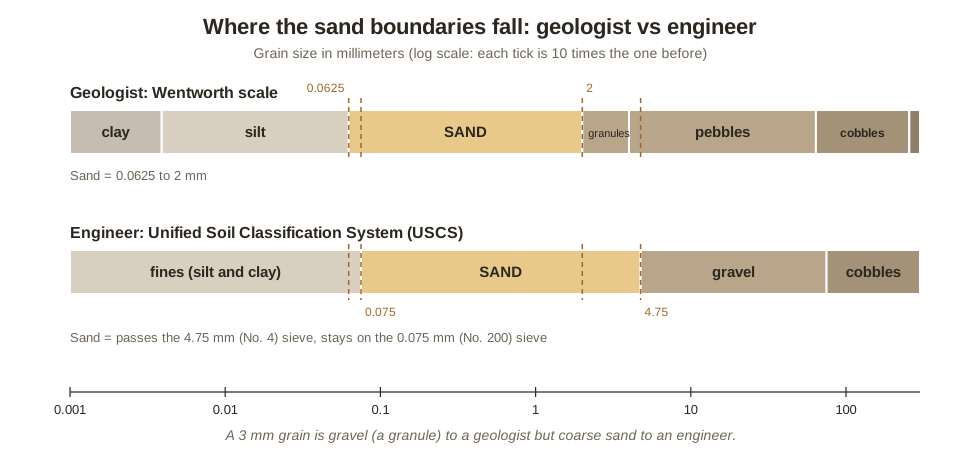
Engineers then classify sand by how its grain sizes are spread and what fine material it contains. SW is well-graded sand, with a good mix of sizes. SP is poorly graded sand, nearly all one size — most beach and dune sand is SP, because waves and wind sort it so thoroughly. SM and SC are sands with silt or clay mixed in. The test behind all of this is a sieve analysis: a sample is shaken through a stack of ever-finer screens, and the weight caught on each one gives a grain-size curve.
Sources
- USGS, sediment size classes
- Caltrans, Unified Soil Classification System chart (PDF)
- The standards themselves are ASTM D2487 (classification) and ASTM D6913 (sieve analysis); both are paid documents.
Why sand stands up — and why it doesn't
Dry sand has no glue. It holds together only by friction between grains, which is why a pile of dry sand always slumps to the same slope, its angle of repose — about 30 to 35 degrees. Angular grains lock together and stand a little steeper; rounded grains roll and lie flatter.
Damp sand behaves very differently. A thin film of water between each pair of grains forms a tiny curved bridge, and the surface tension of those bridges pulls the grains together. Engineers call this "apparent cohesion," and it is why a sandcastle can have vertical walls. A geotechnical engineer writing in Scientific American suggests about one part water to eight parts sand. Too dry and the bridges are too weak; too wet and they disappear, and the sand flows. That vanishing strength is also why a trench dug in damp sand can look safe and then collapse without warning as it dries out or water seeps in.
For foundations, what matters most is how tightly the grains are packed. Loose sand squeezes together and settles when loaded or shaken; dense sand pushes outward and is much stronger. Engineers measure this by drilling and testing before anything is built.
Sources
Testing the ground
Before a road, building or earth fill goes in, engineers test the sand and soil it will sit on. In the 1930s Ralph Proctor showed that every soil has an ideal moisture content at which it packs down the densest; the Proctor test, still used today, finds that point in the lab. Out on site, crews then check that the ground has been compacted close to that lab value.
One of the field tests uses sand as its measuring cup. In the sand cone test, a technician digs a small hole, weighs the soil removed, and then fills the hole with clean, dry sand of a precisely known density poured from a jar through a cone. The amount of sand needed tells you the hole's volume, and so the density of the ground. Deeper down, engineers drive a sampler into the ground with a 63.5 kg (140 lb) hammer and count the blows (the Standard Penetration Test), or push an instrumented cone steadily through the ground (the Cone Penetration Test). More blows or more resistance means denser, stronger sand.
Sources
- Wikipedia, Proctor compaction test
- Wikipedia, Standard penetration test
- FHWA geotechnical manuals library
- Sand cone test standard: ASTM D1556 (paid document).
Liquefaction
In a strong earthquake, loose sand that is soaked with groundwater can briefly lose almost all of its strength. The shaking tries to pack the grains tighter, but the water between them has nowhere to go and barely compresses, so the water pressure rises until the grains are no longer pressing on each other. For a few moments the ground behaves like a thick liquid. Buildings tilt or sink, buried pipes float up, and sand and water burst out of cracks as sand boils or "sand volcanoes."
The classic image is from Niigata, Japan, in 1964, where apartment blocks built on reclaimed land beside the river tilted, and one toppled right over, while the buildings themselves stayed largely intact. In the 1989 Loma Prieta earthquake, San Francisco's Marina District, built on sandy artificial fill over a former lagoon, suffered far worse damage than the firmer ground around it, with more than three times as many water-pipe breaks. In 2010–2011, liquefaction across eastern Christchurch, New Zealand, covered streets in gray silt and sand and led to more than 8,000 homes being bought out and removed.
After Loma Prieta, California passed the Seismic Hazards Mapping Act (1990). The California Geological Survey maps zones where liquefaction is possible, and anyone building inside one must have the ground investigated first. You can look up any address with the state's EQ Zapp map.
Sources
Quicksand
Quicksand isn't a special kind of sand — it's ordinary sand or silt that water is holding loosely apart, often because water is seeping up through it. Left alone it can look and feel firm. Disturb it, and it suddenly flows. Fine, evenly sized, rounded grains tend to be the most prone, because nothing locks them in place. Angular grains of mixed sizes interlock and resist being floated apart.
The movie version is wrong: quicksand cannot suck you under. It is about twice as dense as water, and a person floats in it, sinking at most to around the waist. A study published in Nature in 2005 showed the real danger is being stuck. Once you've sunk in, the sand packs tightly around your legs, and pulling a foot straight out at about 1 cm (half an inch) a second takes a force of roughly 10,000 newtons, which the researchers compared to lifting a car: about the weight of 1 metric ton (2,200 lb). The way out is to move slowly, wriggling so that water can flow back around your legs and loosen the sand. People who have died in quicksand-like mud on tidal flats were usually trapped by the incoming tide, not swallowed. The same mechanism — water flowing up through sand and floating the grains apart — is what engineers call "running sand" when it pours into a trench or tunnel.
Sources
Levees and dams
Most levees and earth dams sit on, or are built from, sand and soil, and moving water is their greatest enemy. During a flood, water seeps under a levee. If it flows fast enough, it starts carrying sand grains out on the dry side, and a small channel, or "pipe," grows backward under the levee toward the river. A sand boil bubbling up behind a levee is the warning sign. Flood crews don't plug it. They build a ring of sandbags around it so water can still escape, but slowly enough that it stops carrying sand. Piping is one of the main ways levees and dams fail in the US and the Netherlands.
The other common way a levee or earth dam fails is overtopping. Water pouring over the crest scours the dry-side slope from the top down, cutting a notch that deepens and widens until the embankment is breached. Overtopping needs the water to reach the top; piping can do its damage at lower water, out of sight, before the flood peaks. A widely cited review of embankment dam failures worldwide found the two about equally common, each behind a little under half of failures.
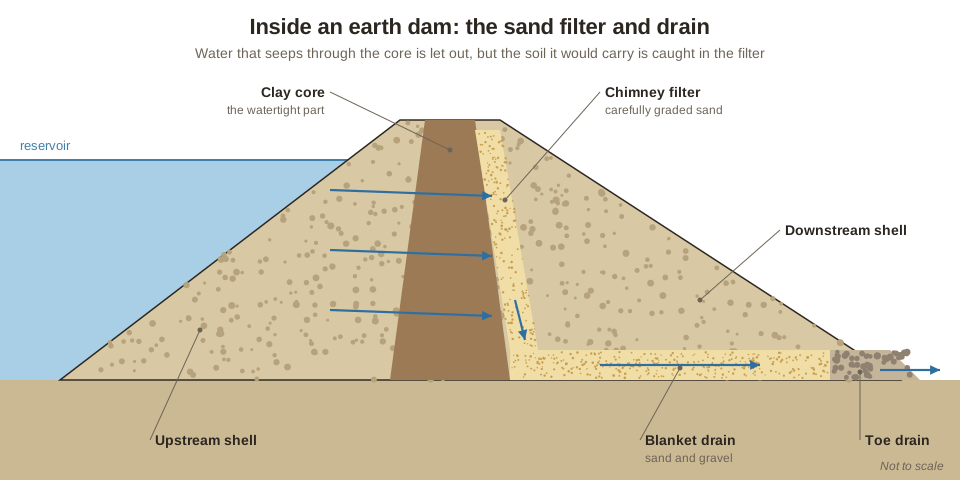
Sand also protects dams. Modern earth dams have filters and drains of carefully graded sand and gravel built inside them, downstream of the watertight core. Water that seeps through can drain away, but the soil particles it would carry are caught in the filter, so the dam doesn't erode from the inside.
Sources
Sand on the move: coastal engineering
Beaches are not fixed. Waves arriving at an angle push sand along the shore, a process called longshore drift. Along San Diego County the net drift runs from north to south. Anything that blocks that river of sand changes the beach. A jetty or groin traps sand on its updrift side, and the beach downdrift is starved and erodes. Dams on rivers trap the sand that would have reached the coast, and seawalls stop the bluffs behind them from feeding sand to the beach. A wide beach is the coast's natural shock absorber: waves spend their energy on the sand before they reach the bluff.
Where a beach is backed by sea cliffs, the cliffs are attacked from two sides. Waves undercut the base, especially in winter storms when the beach in front is stripped thin, until the face above collapses. Water also works from the top down: rain, irrigation and leaking pipes soak in, weaken the rock and help set off slides. Seawalls stop the undercutting, but they also cut off the sand the cliff would have given the beach, and the beach in front of a seawall tends to narrow. How much of any stretch of cliff loss comes from the waves and how much from water seeping in from above is often argued over; usually both play a part.
Close to home: Oceanside Harbor's jetties catch sand drifting south, so the harbor entrance has to be dredged almost every year. The Army Corps of Engineers pumps the sand, usually 150,000 to 230,000 cubic meters (200,000 to 300,000 cubic yards), onto the beaches just south of it. Farther south, the coastal railway at Del Mar runs along bluffs 15 to 21 meters (50 to 70 feet) high that retreat several centimeters (a few inches) a year. Tens of millions of dollars have gone into holding them up since 2003, and the state plans to move the tracks inland. In 2019 a bluff collapse at Grandview Beach in Leucadia killed three people.
From the collection: 0423 Oceanside Pier, just south of the harbor.
Sources
- National Park Service, Groins and Jetties
- Voice of San Diego, history of North County bluff stabilization
- ENR, Del Mar rail line relocation plan
- NBC San Diego, Del Mar bluffs final phase (2024)
- SANDAG, Beach Sand Management
- San Diego Regional Water Quality Control Board, Oceanside Harbor dredging certification (2018; sand placed on Oceanside Beach south of the harbor)
- The Log, "Oceanside Harbor entrance dredging puts sand on beaches"
- Rep. Mike Levin, Army Corps plan to bring sand back to Oceanside's beaches (June 2026)
Improving the ground with sand
Where loose sand could liquefy in an earthquake, engineers can make it denser before building. In vibro-compaction, a large vibrating probe is lowered into the sand, shaking the grains into a tighter arrangement. A related method drives the probe down and fills the hole with compacted stone, making a column that strengthens the ground and lets water drain away during shaking. Loose sand that was pumped into place as hydraulic fill — common on old waterfronts and reclaimed land — is a typical target.
Sand also helps fix soft clay, which is the opposite problem. Clay can take years to settle under a new embankment because water drains out of it so slowly. Installing vertical columns of sand, or today plastic "wick drains," gives the water a short path out, and the clay settles in months instead. Despite the name, a "sand drain" is a drain made of sand, put into clay.
Sources
Running sand in tunnels and trenches
Saturated sand with water flowing through it can pour into a tunnel face, shaft or trench like a liquid. Tunnelers call this running or flowing sand. As with quicksand, it's a condition, not a type of sand. The usual cure is to take the water away first: wells or wellpoints around the dig lower the groundwater before excavation starts. Other options are to freeze the ground solid, inject grout, or use tunnel-boring machines that hold the face up with pressurized slurry or earth. Pumping groundwater has its own risk, though: it can make nearby buildings on soft ground settle.
Part 3 — Everyday life, safety and water Contents ↑
Clean water
Sand has been cleaning drinking water for more than two hundred years. In 1804 John Gibb built a sand filter at his bleachworks in Paisley, Scotland, and sold the surplus clean water to the town. In 1829 James Simpson built filter beds for the Chelsea Waterworks in London, often called the first treated public water supply in the world, and the idea spread quickly.
In a slow sand filter, water trickles down through about a meter (3 feet) of fine sand at roughly 10 centimeters (4 inches) an hour. Within two or three weeks a living slime layer, known by its German name schmutzdecke ("dirt blanket"), grows in the top few millimeters. That layer of microbes does most of the cleaning. It traps particles and eats bacteria and organic matter, removing roughly 90–99% of bacteria with no chemicals at all. The sand mainly holds it up. Modern city plants mostly use rapid sand filters instead. The water is first dosed with a coagulant such as alum, which makes the fine dirt clump together into larger flakes called floc (this step is called flocculation). Most of the floc settles out, and the water then passes quickly through coarser sand, often layered with anthracite coal and garnet. The beds are back-flushed every few days. Backyard pool filters work the same way, with a washed, angular silica sand about 0.5 mm across.
Sources
Sand packs around water wells
Sand also guards the water coming out of a well. Where a well draws from a sand or gravel aquifer, the pipe at that depth is a well screen: a length of slotted or wire-wrapped pipe that lets water in. The gap between the screen and the wall of the drilled hole is filled with a filter pack (also called a sand pack or gravel pack) of clean, rounded, evenly sized quartz sand. The pack is chosen to be a few times coarser than the aquifer's own sand, and the screen slots are sized to hold the pack back. Water flows in easily, but the fine aquifer sand is stopped before it can reach the pump and wear it out. Above the pack, a seal of bentonite clay and cement keeps surface water from running down the outside of the pipe. Wells built to monitor groundwater pollution are made the same way.
Filter-pack sand wants much the same grains as frac sand: rounded, well sorted and hard. Evenly sized round grains leave the most open space between them, and quartz doesn't dissolve the way shell or limestone sand would.
Sandblasting
Benjamin Tilghman patented sandblasting in 1870, using a jet of sand to cut and clean hard surfaces. It is still used to strip paint and rust from ships, bridges and buildings and to etch glass and stone. But quartz sand turned out to be dangerous to blast with: the grains shatter on impact into fine crystalline silica dust that scars the lungs, causing silicosis. In a 1995 government screening of sandblasters in Cleveland, 7% had lung X-rays showing dust disease.
US safety agencies have recommended against silica sand for blasting since the 1970s. US law doesn't ban it, though. Instead OSHA sets a strict limit on how much silica dust workers may breathe. The UK and several other European countries have banned it outright.
Adding water helps. In wet abrasive blasting, water is mixed into the stream to hold the dust down, and NIOSH field tests found workers breathed far less silica than with dry blasting, though not none. Some jobs skip the grit altogether and strip paint with water alone at very high pressure, called hydroblasting or water jetting.
Most blasting today uses other grits: natural garnet sand (the largest use of garnet in the US), crushed glass, steel grit, or slag left over from smelting copper and burning coal. So "sandblasting" today usually means blasting with sand-sized grit that isn't quartz.
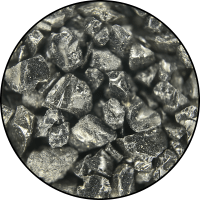
From the collection: 0277 copper slag, a manufactured sand of the kind sold as blasting grit.
Sources
- CDC, Silicosis among abrasive blasters, Cleveland 1995
- NIOSH, Preventing Silicosis and Deaths from Sandblasting (1992)
- NIOSH, study of substitutes for silica sand
- NIOSH, Control Technology for Crystalline Silica Exposures in Construction: Wet Abrasive Blasting
- OSHA respirable crystalline silica standard (construction)
- USGS MCS 2026, Garnet
Sandpaper
Sandpaper is still sand, just rarely natural quartz any more. Most is coated with manufactured grit like aluminum oxide or silicon carbide, or with natural garnet sand. The earliest version on record is from 13th-century China, where crushed shells, seeds and sand were glued to parchment. Quartz sand turned out to be a poor abrasive, because it is brittle and its grains are often rounded, so it was replaced by harder, sharper grit. Aluminium oxide is now the most common, silicon carbide is used for fine wet sanding, and garnet paper is still a favorite for finishing wood. The grit number on the back tells you how fine the grains are: the higher the number, the finer the grit.
Sandbags and ballast
When a flood is coming, sandbags are the first line of defense. The US Army Corps of Engineers recommends bags about 36 by 61 cm (14 by 24 inches), filled only half to two-thirds full so they flatten and fit snugly together, laid like bricks with each row overlapping the joints below. Sand is the easiest fill to shovel and shape, and it gets heavier when wet. Sandbags raise low spots on levees, ring sand boils (see Levees and dams), weigh down plastic sheeting and steer water away from buildings.
They have limits. The Corps says sandbags don't guarantee a watertight seal: they slow and divert water rather than stop it. Floodwater soaking into them is often contaminated, so used bags need careful disposal.
Sand is also handy dead weight, or ballast. Sandbags hold down tents, road signs and tarps. Gas balloonists still climb by pouring sand out of ballast bags, as they have since the 1700s, and sailing ships once carried sand, gravel and stone low in their holds to keep them upright when they sailed without cargo. (Railway "ballast," the bed of stones under the track, is crushed rock, not sand.)
Sources
Grit on icy roads
Sand doesn't melt ice. It just gives tires something to bite on. Road crews use it on hills, curves and intersections when it is too cold for salt to work well. Wisconsin's highway manual, for example, wants angular, fractured grains smaller than about 6 mm (a quarter inch) with almost no dust, pre-wetted with salt brine so it sticks to the road. The downside is where it goes afterwards: much of it washes into storm drains and streams even after the roads are swept.
Sand on the rails
Steel wheels on steel rails can slip, especially on wet leaves, ice or a steep grade. Since the 1800s locomotives have carried a sandbox that drops sand onto the rail just ahead of the driving wheels for extra grip. Early American steam engines had a "sand dome" on top of the boiler, where the heat kept the sand dry so it would flow. The sand has to be dry, clean quartz of a controlled size. One British supplier's rail sand is 0.85–1.7 mm grains from the Leighton Buzzard quarries, and the same sand is sold for water filters. Too much sand has a downside: it can insulate the wheels from the rails and confuse the track circuits that signaling systems use to detect trains.
Hourglasses
Hourglasses appear in European art by 1338, and ships were buying them by the 1340s to time watches and measure speed. Magellan's fleet carried 18. They were no use for finding longitude, but they were perfect for timing a log line to measure a ship's speed in knots. Oddly, many old hourglasses weren't filled with natural sand at all: makers used powdered marble, tin or lead oxides, or crushed burnt eggshell, chosen because the grains were even and flowed smoothly. The flow rate doesn't depend on how full the top bulb is, which is what makes a sandglass a steady timer. What it does depend on is the width of the neck and the size and shape of the grains. Widen the neck a little and the flow speeds up sharply; make the grains too big for the neck and they jam.
Sand against fire
A bucket of dry sand is one of the recommended tools for a small metal fire, such as burning magnesium shavings in a workshop, because it smothers the fire and keeps air out, where water could make things worse. The sand must be dry: damp sand can turn to steam and scatter burning metal. It is not a general-purpose fire extinguisher. For ordinary home fires the advice is a proper rated extinguisher, and a bigger metal fire needs a special Class D extinguisher.
Sand for fish tanks and gardens
Aquarium keepers often use the same washed silica sand sold for pool filters, rinsed well first because the dust clouds the water. Sand made of shell or coral grains is different: it slowly dissolves and makes the water harder and more alkaline. Some keepers choose that on purpose for fish that like hard water.
In the garden, sand is less helpful than people think. University of Missouri Extension warns that mixing sand into clay soil can make it worse: clay fills the gaps between the sand grains and the mix can set almost like brick. Adding organic matter works better. A layer of gravel or sand at the bottom of a pot doesn't improve drainage either; it raises the soggy zone higher in the pot. Where sand does earn its place is in coarse, gritty mixes for cactus and succulents, and as top-dressing on lawns and golf greens.
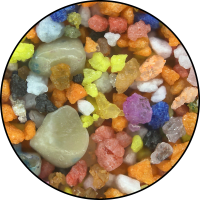
From the collection: 0382, a dyed aquarium sand (manufactured).
Mineral sands: ore you can scoop
Some beach and dune sands are rich ore. Waves and wind concentrate heavy minerals into dark layers and streaks: ilmenite and rutile (titanium), zircon, monazite (a source of rare-earth elements) and garnet. These deposits are mined in Florida, Georgia and Virginia, and on a much larger scale in Australia, Africa and Asia. The minerals are separated from the lighter quartz by their weight and their magnetism.
The titanium is mostly turned into titanium dioxide, the bright white pigment in paint, paper and plastics. More than 95% of titanium minerals go that way. Only a small share ends up in sunscreen. Zircon goes mainly into ceramic tiles and glazes, and also foundry molds. Monazite is mildly radioactive because it contains thorium, though the amount in ordinary black beach sand is small. Gold collects the same way: being heavy, it settles in stream gravels and on beaches as placer deposits, such as the old raised beaches around Nome, Alaska.
Sources
Is there sand in your toothpaste?
No — even though the label says "silica." The hydrated silica in toothpaste is a manufactured, water-bearing form of silica, made to be a gentle scrubber and thickener, not crystalline quartz grains. It is a different material from the quartz dust that causes silicosis. Natural quartz sand does go into many everyday things indirectly, though. It is the raw material for glass, for the silicon in electronics, and for the silicones in sealants, cookware and cosmetics.
Sources
Part 4 — Sport, art, culture and nature Contents ↑
Golf bunkers
Golf course managers take their bunker sand seriously enough to look at it under a microscope. The US Golf Association's Green Section names seven things to test: grain size, grain shape, how easily it crusts, its hardness and chemistry, how fast water drains through it, its color, and how deep a dropped ball sinks. That last one is measured with a penetrometer. A high reading means less chance of the dreaded "fried egg" lie, where the ball is buried in its own crater.
Most bunker sand falls between about 0.1 and 1 mm. Angular grains lock together, so they resist burial and let the steep face of a bunker hold its shape. Very round sand stays soft, buries balls and blows away. Too angular, though, and the sand packs hard, which some golfers dislike. The sand must also be clean: silt and clay make it crust over and turn bunkers into bathtubs after rain. White or off-white sand is popular for looks, but real courses use everything from off-white to dark brown.
Sources
Golf greens
A putting green is mostly sand. The USGA's recommended design is about 30 cm (12 inches) of a carefully graded sand mix over a layer of gravel. The difference in grain size between the two layers holds water in the sand just long enough for the grass roots, then lets the rest drain away quickly. The sand has to be mostly medium to coarse, with only small amounts of fine sand, silt and clay, and it is specified by its full spread of grain sizes, not just called "sand." Over the years, fine material builds up in the root zone, which is why greens are regularly topped up with fresh sand.
Beach volleyball
Pro and Olympic beach volleyball is rarely played on the beach the venue happens to sit on. The international federation, FIVB, requires sand at least 40 cm (about 16 inches) deep, free of stones, shells and anything that could cut, and tested and approved by an official sand laboratory before a tournament. Most of the grains should be medium to coarse, roughly 0.5 to 2 mm. Finer sand turns dusty and packs hard. The grains should be naturally weathered and rounded, never crushed rock, whose sharp broken grains pack down and cut skin. The color should be a soft tan that doesn't glare. For the Tokyo Olympics, about 3,500 tons of sand were shipped from Vietnam.
From the collection: 0368 Manhattan Beach, home of classic Southern California beach volleyball.
Sources
Horse arenas and racetracks
What a horse runs on matters for its legs. Penn State Extension recommends riding arenas use clean, screened medium-to-coarse sand, about 5 cm (2 inches) deep and never more than about 15 cm (6 inches), with very little fine dust. Sub-angular grains work best. Rounded river or beach sand rolls underfoot "like ball bearings," while very sharp crushed sand packs hard and wears hooves. Quartz sand lasts much longer than softer limestone sand.
Racetracks are a recipe. The dirt track at Churchill Downs, home of the Kentucky Derby, is roughly three-quarters rounded sand with silt and a little clay to bind it, over a firmer base. Its moisture is watched closely.
Sources
Sandboxes and play sand
Sand is one of the loose surfaces the US Consumer Product Safety Commission lists for under playground equipment, along with wood chips, pea gravel and rubber mulch, because a deep layer softens falls. Play sand sold for sandboxes is washed and screened quartz sand, cleaned of stones and dust.
There has been a real safety scare, though not the one often repeated online. In November 2025 New Zealand recalled several brands of colored craft sand after testing found tremolite, a naturally occurring mineral that can take the form of asbestos fibers. Schools and childcare centers closed rooms to test them. In 2026 the US recalled some sand-filled squeeze toys over the same mineral. These cases involved specific products, not play sand in general.
Sources
Baseball infields and artificial turf
A baseball infield isn't pure sand. It's a blend of sand, silt and clay, adjusted so the ground is firm enough for a true bounce but soft enough to slide on. Professional fields generally use more clay and silt than school fields. Artificial turf uses sand too: rounded silica sand is spread between the plastic blades to weigh the carpet down and keep the blades standing up.
Sand mandalas
Tibetan Buddhist monks create sand mandalas, intricate circular diagrams of the universe, grain by grain, working from the center outward. Each monk taps colored sand out of a narrow metal funnel called a chak-pur. A large mandala can take weeks: one made by monks of the Drepung Loseling Monastery at the Smithsonian in 2002 took about three. When it's finished, the mandala is ceremonially swept away to show that nothing lasts. The sand is collected, some is shared with those present, and the rest is poured into flowing water. At the Smithsonian it went into the Potomac River. The "sand" is usually finely ground white stone colored with pigments, chosen because it flows smoothly from the funnel.
Diné (Navajo) sandpainting
For the Diné, the Navajo people, sandpainting is part of sacred healing ceremonies, not an art form. A ceremonial practitioner, a hataałii, trickles colored sand, crushed minerals, charcoal and plant pigments through the fingers to create images of the Holy People on the floor of the hogan. The patient sits on the painting, which is believed to draw out the illness, and afterward the painting is destroyed, all within about twelve hours. Sacred sandpaintings are rarely photographed and are not meant to be copied. The sandpaintings sold to visitors, glued onto boards since about the mid-1900s, deliberately change the designs so they are not sacred copies.
Sources
Sand sculpture
Competition sand sculptors don't use pretty beach sand. Good sculpting sand is slightly "dirty": a small amount of silt and clay helps glue the grains, and angular grains of mixed sizes lock together. Sand rounded and sorted by the waves, which is most beach sand, won't stand very tall. That's why big sand-sculpture festivals usually truck in quarried or river sand. Dutch sculptors, for example, favor river sand from near Nijmegen. Water does the rest, with the same tiny bridges between grains that hold up a sandcastle (see "Why sand stands up").
Sources
Sand bottles and sand animation
Layered sand art is poured into glass bottles one color at a time to build up landscapes and patterns, and it's a long-standing souvenir craft in many desert regions. Sand animation is a performance art. The artist draws in a thin layer of sand on a back-lit glass table, changing the picture by sweeping and trickling grains. Hungarian animator Ferenc Cakó's sand film Ashes (1996) won the Golden Bear for short film at the Berlin Film Festival. Ukrainian artist Kseniya Simonova won Ukraine's Got Talent in 2009 with a sand story about the Second World War that has since been watched millions of times online.
Sand casting in art and jewelry
The same molding sand that makes engine blocks is used by artists and jewelers. A pattern is pressed into fine sand bound with clay or oil, removed, and molten metal is poured into the hollow it leaves. Sand casting gives a matte, slightly rough surface and less fine detail than lost-wax casting, which many artists value for one-off pieces. Finer sand gives a smoother finish, but it lets the hot gases escape less easily. More than half of all metal castings in the world are made in sand molds.
Grunion: fish that spawn on the sand
On spring and summer nights, just after the highest tides, California grunion ride the waves up onto Southern California beaches to spawn on the sand itself. The female digs tail-first into the wet sand until she is buried up to her head and lays about 1,600 to 3,600 eggs, while males curl around her to fertilize them. The eggs incubate under the sand for about ten days until the next set of high tides washes them out and they hatch. Runs come on the nights after full and new moons, from March to August. Grunion may be caught by hand only, and not at all from April through June, and beach grooming and heavy foot traffic can destroy the buried eggs.
Sea turtles: sand sets the sex
Sea turtles bury their eggs in beach sand, and the temperature of that sand decides whether the hatchlings are male or female. Around 29 °C (84 °F) produces about half of each; warmer nests produce mostly females, cooler ones mostly males. The exact tipping point varies a little between species and populations. Sand color and shade change nest temperature, so the beach itself shapes the next generation. On Australia's Raine Island, warming has meant green turtle nests have produced almost all females since the 1990s.
Western snowy plover
The western snowy plover, a small shorebird listed as federally threatened since 1993, nests right on open sand. Its "nest" is a shallow scrape holding about three speckled eggs that look so much like sand they are easily stepped on. Nesting runs from March to September, which is why stretches of some California beaches are roped off in summer.
Sources
Water underground: sand and gravel aquifers
Much of the groundwater people drink is stored in the spaces between sand and gravel grains. Clean, well-sorted sand and gravel hold a lot of water and let it flow easily to wells. The same openness lets pollution in easily too. USGS groups these aquifers into types such as basin fill, coastal blanket sands, glacial deposits and stream valleys. Some are a few meters (10 feet or so) thick; others, in the basins of the American Southwest, are hundreds of meters (well over 1,000 feet) thick. California's Central Valley aquifer is one of the big ones. Along coasts, pumping too much can draw seawater into the sand. Wells that draw from these aquifers are finished with a sand filter pack (see "Sand packs around water wells" in Part 3).
Dating a grain of sand
Sand can tell time. Once a quartz grain is buried, natural radiation from the surrounding ground slowly builds up stored energy in its crystal. Sunlight empties that store, and burial starts it filling again. In the lab, working under dim red light, scientists stimulate the grains with light and measure the glow they give off. Dividing the stored dose by the yearly radiation rate gives the time since the grain last saw daylight. This is optically stimulated luminescence (OSL) dating, useful back to roughly 100,000 years or more. Wind-blown dune sand is ideal, because it was thoroughly sunlit before burial. At Blombos Cave in South Africa, researchers measured nearly 9,000 individual quartz grains from dune sand to date a layer to about 66,000 to 69,000 years ago. OSL dates the burial, not the age of the grain itself.
Sources
Sand as evidence
Sand and soil cling to shoes, tires, tools and clothes, and every place's sand is a slightly different mix of minerals, grain shapes, shell fragments and human-made bits. Forensic geologists compare these "fingerprints" to link a person or object to a place. Sand can show that two samples are consistent with each other, but it rarely proves they came from one exact spot. One of the earliest recorded cases, from 1856 Prussia, reportedly involved a railway shipment of silver coins swapped for sand along the route, and the sand was traced to the station where the theft happened.
Dunes: nature's sea wall
Sand dunes are a coast's first line of defense against storms. After Hurricane Sandy in 2012, the US Geological Survey found that dune height largely decided which beaches held and which were overwashed. Tall, unbroken dunes south of Virginia Beach, averaging over 6 meters (20 feet), held. Lower New Jersey dunes, averaging about 3 meters (10 feet), lost more than half their height, and almost half the dunes on New York's Fire Island were overwashed. Dune grasses trap blowing sand and help dunes rebuild, but natural recovery takes years to decades. Dunes cushion big storms rather than stopping them.